
Key takeaways
- Internal approval does not prove that an external submission occurred.
- Review the actual document package as well as its index.
- Assign the external submission action and preserve its separate evidence.
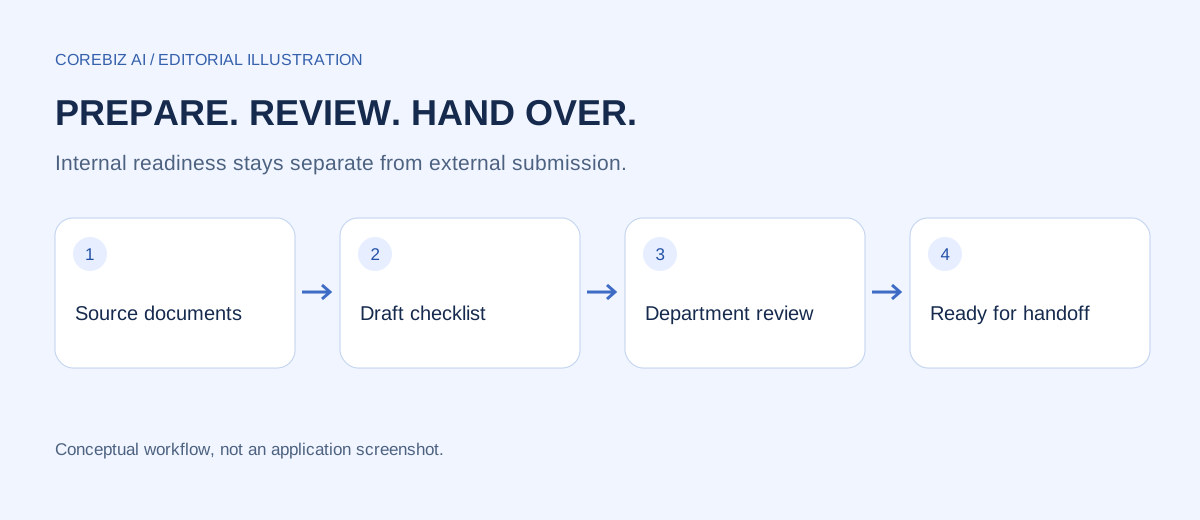
Internal readiness means the team has completed its agreed preparation and review. It does not mean an external submission has occurred. Keeping those two statements separate helps coordinators report progress honestly and prevents a completed internal workflow from being mistaken for an official outcome.
This guide describes a final internal review for teams using GeM Flow. The application has no official GeM connection and does not submit bids. The examples concern organizing the team's work, not interpreting tender rules or giving a procedure for a particular official portal.
Define what ready means for your team
Write a short internal definition of readiness before the final review. It might require confirmed source references, reviewed checklist items, resolved department corrections and a known set of document versions. The definition should describe the evidence the coordinator can actually inspect.
Avoid a definition based only on status labels. A project can display an advanced status while the underlying package still contains an outdated attachment or an unanswered question. Readiness needs an explanation of what was checked and which limitations remain.
Distinguish readiness from authority to act
The person organizing the package may not be the person authorized to perform an external submission. Name the responsible actor and the internal arrangement for handing over the prepared material. The workspace should not leave that responsibility implied by whoever last changed a status.
Also identify the person who resolves last-minute questions. A coordinator who discovers conflicting document versions needs a decision route. Without it, the final preparation period can become a search for somebody willing to approve a change they have not had time to understand.
Review the source version one last time
Confirm which source documents and updates the internal work is based on. GeM Flow does not monitor the official portal for changes. The team's responsible person must check the authoritative source through the appropriate external process and communicate any update that affects preparation.
If an update is found, determine its impact before continuing. It may change a requirement, a date or the meaning of previously reviewed evidence. Do not assume that a small-looking change is irrelevant without asking the department responsible for the affected decision.
Record the effect of changes
A useful change note states what changed, which checklist or document items were affected and who reviewed the impact. This gives the final coordinator a reason to trust the updated package. A note saying updated documents uploaded does not explain whether earlier approvals still apply.
If the team cannot resolve the impact in time for its internal plan, report that uncertainty explicitly. A readiness review should expose a blocking question, not hide it behind a completed checklist so the project appears on schedule.
Compare the index with the actual files
GeM Flow can export a text submission index. Treat it as a navigation aid that identifies material, not as a complete archive of the documents themselves. The index does not prove that every referenced file is present, readable or suitable for external submission.
Open the actual package through the team's approved preparation method. Match each referenced item to the intended file and version. A correctly named index entry can still point to a document that was replaced, omitted or prepared in an unsuitable form.
Look for practical packaging mistakes
Check for duplicate files with unclear names, missing pages and attachments that cannot be opened. These are ordinary preparation problems that may not be visible in a high-level review status. Assign any correction to a named person and confirm what was changed.
Do not infer that a text export is a ZIP download. The current application does not create a ZIP of all submission documents. If the team's external process requires a particular package, assemble it separately and review it according to the authoritative instructions for that process.
Resolve open questions before declaring readiness
Read the department correction history and project discussions for unresolved issues. A question can remain in a discussion even after another part of the project moves forward. Ask whether it was answered, explicitly accepted as a limitation or still requires a decision.
Separate an open action from a future improvement idea. An unresolved missing document may block preparation, while a suggestion to improve next month's naming convention may not. The final review should distinguish those categories rather than treating every comment as either irrelevant or equally urgent.
Make exceptions explicit
If the responsible team decides to proceed with a known limitation, record the limitation and who made that decision. Do not present the package as complete in an unqualified summary while relying on a private conversation to explain an exception.
The application history supports internal traceability, but it does not determine whether an exception is acceptable under an external requirement. That judgment must come from the appropriate source and responsible people. Avoid describing an internal approval as a guarantee of external compliance.
Prepare a clear external handoff
Give the responsible submitter a concise package summary. It should identify the current source basis, the intended files and any relevant internal decisions. The handoff should help them recognize the package they are receiving without forcing them to read every discussion from the beginning.
Confirm that the person has the access and authority needed for their external role through the organization's normal process. Do not place account passwords or recovery material in a shared project document. Access arrangements and document preparation need appropriate separate handling.
Agree how the submitter will communicate completion or a problem back to the coordinator. The team should not infer success from silence or from the fact that the package was handed over. A clear return message closes the operational loop without overstating what the workspace itself can observe.
Preserve the evidence of the external outcome
After the external action, retain the appropriate confirmation or error information from that process in the team's authorized records. The internal project history and the external confirmation answer different questions. One records preparation decisions; the other records what happened outside the workspace.
Do not invent a confirmation because internal approvals are complete. If the action failed or was not performed, report that status accurately and identify the next decision. A truthful incomplete state is more useful than a completed label that nobody can substantiate.
Keep outcome language precise
Use terms such as internally approved, handed over for submission and externally submitted only when the corresponding event occurred. Avoid a generic done when different readers may understand it differently. Precise wording helps management distinguish preparation progress from external completion.
The same caution applies to results after submission. A recorded external submission is not automatically an award, acceptance or successful outcome. Keep later events separate and support them with their own evidence rather than letting one status imply the entire lifecycle.
Run a fictional final review
Imagine a fictional equipment project whose departments have completed their internal reviews. The coordinator exports the index and discovers that one referenced supporting file has two similarly named versions. The responsible department identifies the version it actually reviewed, and the package summary is corrected before handoff.
The submitter receives the package and later reports that an external action remains incomplete because a required step needs attention. The coordinator records the actual situation instead of marking the whole effort successful. The internal readiness work remains useful, but it is not confused with an event that has not occurred.
Frequently asked questions
Can GeM Flow submit the bid for us?
No. The current installation is an internal tender preparation and review workspace. It has no official portal connection or automatic bid submission capability. The responsible team must perform external actions through the appropriate official process and retain the relevant evidence separately.
Is an exported index enough for the final review?
No. Use it to navigate the intended documents, then inspect the actual files and versions. An index describes a collection; it does not establish that the collection is complete or that every file is suitable for the external task.
What if a department changes a document after approval?
Identify what changed and ask which earlier decisions are affected. The team may need a focused follow-up review before relying on the updated package. Do not assume that approval of an earlier version automatically covers a materially different replacement.
Conclusion
Define internal readiness through evidence, reviewed versions and named responsibility. Inspect the actual package, then hand it to the person responsible for the external action. Keep preparation, submission and later outcomes distinct so every progress statement means something the team can substantiate.
Explore the project and implementation options
The GeM Flow project page explains the available workspace and its access requirements. Use it to compare the process described here with the current application. The automation service page is a starting point for discussing additional workflow requirements; this article does not imply those customizations are already implemented.
Prepared with AI assistance and checked against the project source. Examples are fictional process illustrations, not customer results. GeM Flow is an independent internal workspace, not an official GeM service.
Discuss a focused implementation
Explore the service scope and share the process you want to improve.
Explore this service