
Key takeaways
- Capture the source and its version before assigning internal review.
- Separate confirmed information from unanswered questions.
- Treat workspace deadlines as planning records, not official portal confirmation.
Tender intake should produce a shared record that lets the next reviewer understand what is being considered and where the source material came from. Start with the reference, documents, dates and responsible coordinator. A large folder of files without that context is difficult to review consistently.
This guide describes internal organization for a team using GeM Flow. It does not explain official bidding requirements or replace the current tender documents. The application is an independent preparation workspace and has no official GeM portal connection or automatic bid submission.
Capture the source before interpreting it
Record the tender reference exactly as it appears in the source being reviewed. Add a recognizable internal title so colleagues can distinguish it from similar work. A shortened project name is convenient for navigation, but it should not replace the original reference needed to identify the source.
Keep the source document and its retrieval context together in the team's records. A reviewer should know which version formed the basis for the intake. If the team is relying on an attachment received through another person, identify that provenance rather than presenting it as independently verified.
Separate source facts from internal assumptions
A date copied from a document is a source fact, while the team's proposed review date is an internal planning choice. Label them accordingly. Combining both into a single deadline without explanation makes it harder to understand what a reminder actually means.
Likewise, keep unanswered questions visible. If a product description appears ambiguous, record the question and the person responsible for resolving it. Filling an uncertain field with a plausible guess can cause later reviewers to treat an interpretation as a confirmed requirement.
Establish ownership at the intake stage
Name a coordinator responsible for assembling the record and keeping it coherent. The coordinator does not need to make every technical or commercial decision. Their role is to ensure that questions reach the right reviewer and that the result returns to the shared project context.
Identify the departments that need to participate. A technical team may examine specifications, while another team reviews commercial information or document availability. Describe the decision each department is expected to make instead of simply adding every available user to the project.
Make the first handoff actionable
The first reviewer should receive a specific question, such as whether the proposed item can meet the described operating conditions. A generic request to check everything encourages shallow review and duplicated effort. Focus makes it easier to identify missing expertise before the work moves forward.
Record the evidence the department needs. If the technical decision depends on a manufacturer document, collect that document or flag the dependency. Assigning a review before the necessary evidence is available may create a visible task without creating a realistic path to completion.
Organize the documents by their purpose
Group source material, working drafts and supporting evidence conceptually, even if they are presented through a single library view. The team should be able to distinguish what was received from what it created. A working checklist should not be mistaken for the original tender specification.
Use filenames and descriptions that help a colleague recognize the document. Include a version or date when meaningful, and avoid names such as latest-final-new. Clear naming reduces the chance that a reviewer opens an obsolete attachment simply because it appears first.
Do not upload every internal file merely because it might become useful. Include material relevant to the review and restrict sensitive information to the people who need it. An intake package should support a decision without becoming an uncontrolled copy of the organization's document archive.
Create a list of review questions
Turn unclear areas into explicit questions before asking for approval. A question might concern the relationship between a specification and an available document, the meaning of a date, or the ownership of a required response. Assigning the question is more useful than hiding it in a long summary.
Keep questions linked to their source location where possible. A page, section heading or quoted phrase helps the next person find the context. Avoid copying large sections without explanation; the reviewer should understand why the passage matters and what decision remains open.
Use draft analysis as an assistant to preparation
GeM Flow can suggest draft checklist items through rule-based analysis of available source text. Those suggestions are starting points for human review. They are not a certification that the source has been fully understood, and the application does not provide an external AI review service.
If the source is a scan without usable text, do not assume the tool has read it. This installation does not provide OCR. Arrange a human-readable review method and document any transcription work so the team understands the basis of the resulting checklist.
Plan internal dates around the actual work
Start with the team's available source deadline, then work backward to internal review and correction dates. Include time for a department to return a question and for the coordinator to assemble the response. A schedule that allows only first-pass approval leaves no room for ordinary clarification.
Internal dates should be reviewed when the source changes. GeM Flow does not monitor the official portal for updates. The coordinator needs an agreed routine for checking the authoritative source outside the application and recording changes that affect the internal plan.
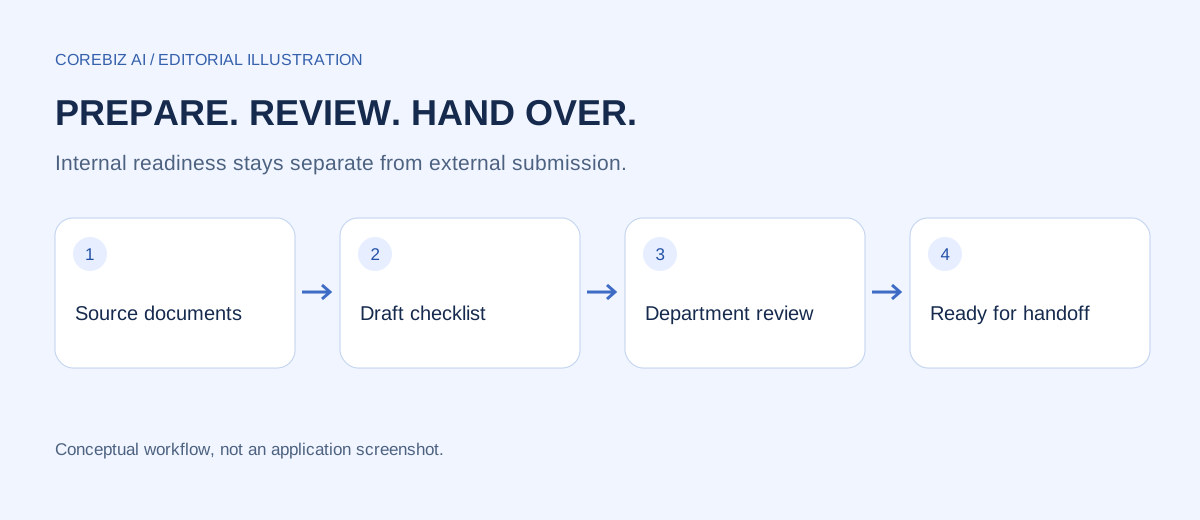
Do not present a workspace status as proof that a bid was submitted or accepted externally. Internal preparation and official submission are separate processes. The intake record should help the team prepare responsibly while keeping the final external action clearly assigned.
Use a fictional intake example
Suppose a team is considering a fictional equipment tender. The coordinator records the reference, saves the available source document and opens questions about the described operating environment. The technical department needs to compare that environment with the proposed equipment documentation before the plan can move forward.
The coordinator also notes that one supporting document is still being requested. Instead of marking the intake complete, the team records the missing item and its owner. The first review can then focus on the evidence already available while the dependency remains visible.
Later, an updated source document arrives. The coordinator records the new version and identifies which questions or checklist items may be affected. Reviewers are told what changed, so they do not continue approving an earlier interpretation without realizing that the basis has moved.
Prepare the transition into department review
Before advancing the project, read the intake as a person who did not attend the initial discussion. Check that the reference is recognizable, the source version is clear and the open questions have owners. A department should not need to reconstruct basic context from private messages.
Summarize what is ready for review and what remains unresolved. These are separate statements. A project can have enough information for a technical review while still waiting for another document, provided that limitation is explicit and the review decision is appropriately scoped.
Frequently asked questions
Does creating a project register anything on GeM?
No. GeM Flow stores an internal preparation record. It has no official portal connection and does not create or submit an external bid. The responsible team must handle official actions through the appropriate external process and keep their own evidence of those actions.
Should all questions be resolved before review starts?
Not necessarily. Some questions require the department's expertise. The important point is to identify them clearly and distinguish a request for analysis from a request for approval. Do not imply that unresolved information has been confirmed merely because the project has entered a review stage.
Can sample projects be used as real intake records?
Treat included sample records as demonstrations. Create a properly identified project for actual work and replace illustrative information with reviewed source facts. Copying a sample without checking its assumptions can introduce misleading names, dates or decisions into the team's record.
Conclusion
Build intake around a traceable source, a named coordinator and explicit review questions. Keep assumptions visible and distinguish internal planning from external submission. A well-prepared record gives each department a useful starting point and reduces the need to rediscover context at every handoff.
Explore the project and implementation options
The GeM Flow project page explains the available workspace and its access requirements. Use it to compare the process described here with the current application. The automation service page is a starting point for discussing additional workflow requirements; this article does not imply those customizations are already implemented.
Prepared with AI assistance and checked against the project source. Examples are fictional process illustrations, not customer results. GeM Flow is an independent internal workspace, not an official GeM service.
Discuss a focused implementation
Explore the service scope and share the process you want to improve.
Explore this service