
Key takeaways
- Give each department a decision it is qualified to make.
- A correction request should name the gap and the evidence needed to resolve it.
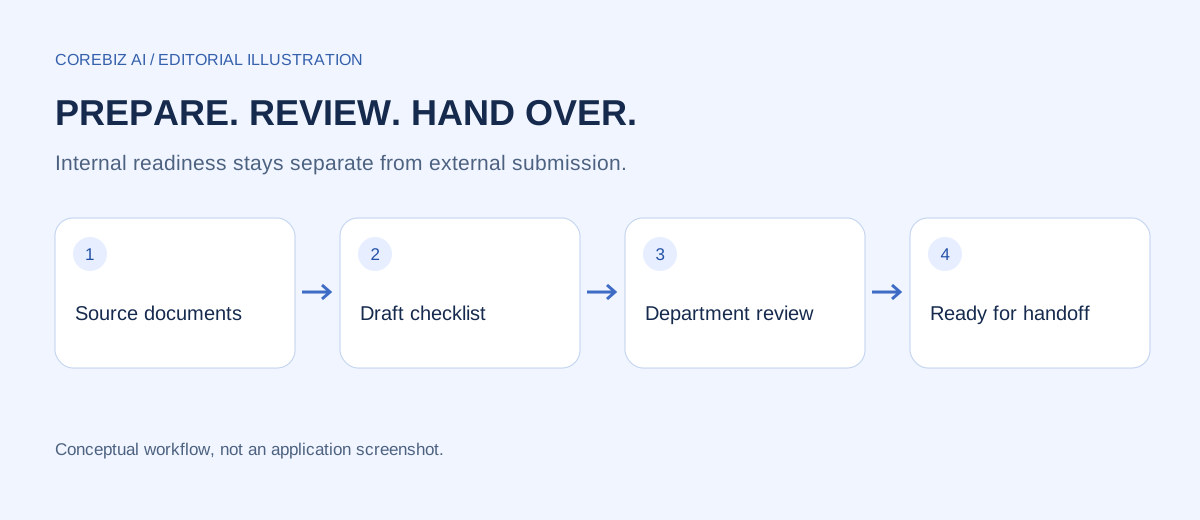
- Keep internal approval distinct from official submission or acceptance.
A department approval is useful only when everyone understands what that department examined and accepted. Sending a project from one team to another without a defined review question can produce a long approval history with little meaningful assurance. Start by naming the decision behind each handoff.
GeM Flow provides sequential internal department reviews and correction requests. This guide explains how a team can prepare useful work for that sequence. It does not describe an official procurement approval process or suggest that an internal status establishes external eligibility or acceptance.
Assign decisions according to expertise
Write the question each department should answer. A technical reviewer may assess whether the proposed solution matches the described operating conditions. A commercial reviewer may examine the internal pricing assumptions. A coordinator may confirm that the document package contains the versions the reviewers actually considered.
Avoid a generic instruction to approve the tender. That phrase does not identify which aspects were reviewed and which remain outside the department's expertise. A reviewer should be able to state the scope of their decision without claiming responsibility for every other team's work.
Define the expected evidence
For each question, identify the supporting material needed. Technical review might require a specification and a corresponding product document. Another department might need an internal cost explanation. The evidence should match the decision rather than simply reproduce the entire project library.
If the evidence is not ready, say so before requesting approval. The department can help identify what is missing, but that is an analysis task rather than a completed acceptance decision. Keeping the distinction visible prevents an incomplete package from appearing approved by default.
Choose an order that reflects dependencies
Sequential review works best when later decisions can rely on the earlier ones. If a commercial calculation depends on the proposed configuration, the configuration needs enough clarity before the commercial review. Otherwise, the second department may evaluate an assumption that the first department later changes.
Discuss the order with the people doing the work. A sequence copied from another project may be inappropriate when the main uncertainty is different. GeM Flow supports a sequential workflow, but selecting useful responsibilities remains a planning task for the team.
Prepare parallel work without confusing the approval chain
Colleagues can collect documents or investigate questions while another department reviews. That preparatory work does not mean the later formal review has already occurred. Keep the visible approval sequence aligned with the actual decisions so the record remains understandable.
If a later reviewer provides early advice, record it as advice in the project discussion. Do not present it as final approval of a package they have not yet seen. When the formal handoff arrives, they should receive the current evidence and any relevant changes.
Write a handoff note that answers three questions
The receiving department needs to know what is ready, what decision is requested and what remains uncertain. A short handoff note can answer all three. The purpose is to reduce the time spent reconstructing context from scattered messages and file names.
For a fictional equipment project, the note might explain that the proposed configuration is documented, the department should review operating suitability, and one supporting clarification remains open. That is more actionable than a notification saying the project has moved to review.
Reference the specific document versions. If a reviewer opens a library item that has changed since the handoff, the decision can become difficult to interpret. The project discussion should make clear which evidence supported the requested review and how later updates will be communicated.
Make correction requests specific
A correction request should identify the gap, its effect on the review and the evidence needed to resolve it. For example, the proposed specification and the supporting document may describe different configurations. The coordinator needs to know which discrepancy to address before resubmitting.
Avoid returning a project with a comment such as documents incomplete. Name the missing document or missing information, and explain the source of the expectation. A concrete correction request helps the submitting team act without requiring another meeting simply to interpret the feedback.
Distinguish missing evidence from disagreement
Sometimes the document exists but the reviewer disagrees with the interpretation. That requires a discussion of the reasoning, not another copy of the same file. Ask the reviewer to explain which source passage or assumption leads to their concern so the response can address the real issue.
If two departments disagree, the coordinator should make the conflicting assumptions visible. Do not resolve the conflict by choosing whichever status moves the project forward faster. Assign the decision to the appropriate responsible person and record the outcome before treating the issue as settled.
Resubmit with a change summary
When corrections are complete, summarize what changed and reference the updated evidence. The reviewer should not need to compare every file from scratch to discover whether their concern was addressed. A focused response makes the second review more precise without preventing a broader check where necessary.
Identify any requested change that was not made. Explain whether it remains open, was resolved through clarification or needs a separate decision. Silence can be mistaken for compliance with the request and leave the history misleading even when the team believed the issue had been discussed.
Revisit affected earlier decisions
A correction can affect more than the department that requested it. If a proposed configuration changes, an earlier technical decision or an associated cost assumption may no longer apply. The team should discuss the impact rather than assuming that previous approvals cover every later version.
Use the workspace history to find the relevant context, then make the current decision explicit. Audit history helps explain what happened, but it does not automatically decide whether an earlier approval remains valid after a substantive change.
Treat notifications as prompts, not proof
A notification can tell a person that work is waiting. It does not establish that they opened the document, understood the issue or made the required decision. The meaningful record is the review outcome and its explanation, supported by the evidence available at that point.
In the current GeM Flow installation, email transport is disabled. Do not design the team's routine around an assumed external email delivery. Use the workspace and an agreed human follow-up practice, and distinguish a recorded internal notification from a message actually delivered through an external service.
Use a practical review meeting sparingly
A short discussion can help resolve a complex disagreement, but the result should return to the project record. Capture the question, the chosen interpretation and any follow-up action. Otherwise, the next reviewer may see a changed status without understanding why the earlier concern disappeared.
Invite the people needed for the decision rather than every project participant. A focused meeting is easier to conclude with a clear owner. If the question remains unresolved, record that outcome honestly and identify the information needed before the team can decide.
Frequently asked questions
Does every department need to review every project?
The team should select reviewers according to the actual decisions and responsibilities involved. Unnecessary reviews create delay without necessarily adding useful scrutiny. Conversely, omitting a required area of expertise can leave an important assumption unchecked. Establish the sequence deliberately for the project context.
Can an administrator replace a department's judgment?
An administrator may manage the workspace, but technical access is not the same as subject-matter authority. The team should define who is responsible for each decision. Do not infer that a person is qualified to approve every issue simply because they can administer the application.
Does final internal approval mean the bid was submitted?
No. GeM Flow is an internal preparation workspace and has no official portal submission integration. The team must handle the external action separately and preserve the appropriate evidence from that process. Internal readiness and external completion should be communicated as different states.
Conclusion
Give each department a clear question, relevant evidence and an understandable handoff. Make correction requests specific and explain changes when resubmitting. The resulting review history should reveal what the team decided and why, rather than only showing that a project passed through a sequence of names.
Explore the project and implementation options
The GeM Flow project page explains the available workspace and its access requirements. Use it to compare the process described here with the current application. The automation service page is a starting point for discussing additional workflow requirements; this article does not imply those customizations are already implemented.
Prepared with AI assistance and checked against the project source. Examples are fictional process illustrations, not customer results. GeM Flow is an independent internal workspace, not an official GeM service.
Discuss a focused implementation
Explore the service scope and share the process you want to improve.
Explore this service