
Key takeaways
- Handover needs operational ownership as well as accepted features.
- Transfer access through appropriate channels and document who controls each service.
- Keep unresolved issues and future support separate from completed delivery.
A software handover is complete only when the client can locate what was delivered, understand how to operate it and identify who owns the next action. A successful demonstration is useful, but it does not replace access arrangements, operating notes or an agreed support boundary.
This guide is for a studio approaching the final stage of a client project. It uses a fictional internal application as an example. The suggested handover package should be tailored to the agreed scope and actual operating responsibilities rather than copied as a universal contract checklist.
Define what the final stage includes
Return to the published stage plan and identify the promised handover deliverables. These might include deployment, administrator instructions and a summary of accepted behaviour. If training or ongoing maintenance is outside scope, say so clearly instead of leaving the client to infer it from the final invoice.
Separate delivery completion from continuing operation. The application may be delivered while hosting, renewals or routine administration remain ongoing responsibilities. The handover should name those responsibilities so a completed project does not leave an operational task without an owner.
Make the inventory specific
List the application locations, documentation references and supporting materials the client will receive. Use descriptive names that match the actual resources. A folder labelled documents is less useful than a short inventory explaining which file covers access, daily operations or release information.
For each item, state its purpose and owner. The client should know whether a document is a user guide, a technical reference or a record of acceptance. That context helps a new employee use the package without first contacting the original project manager.
Arrange access without putting secrets in documents
Identify who controls the application administrator account and any supporting services included in scope. Ownership matters as much as the existence of a login. If the client cannot administer their own account or arrange a renewal, the operational dependency should be made explicit.
Do not paste passwords, private keys or environment values into a general handover file. Describe the access process and transfer sensitive material through an appropriate agreed channel. A useful operating guide explains where access is managed without becoming a repository of reusable secrets.
Separate individual access from shared responsibility
Where individual accounts are available, assign them to the people who need access. A shared project login can make later decisions difficult to attribute. The handover should explain the intended roles and how the responsible administrator grants or removes access through supported controls.
Review temporary demonstration arrangements. Test accounts, synthetic records and review environments may have different purposes from production access. Identify which are retained for training and which require an agreed cleanup action, without deleting useful records simply because the project is reaching its last stage.
Explain the everyday operating path
Start the user guide with a real task rather than a tour of every menu. For the fictional application, describe how an employee creates a request, how the reviewer returns it for correction and where the final decision appears. Organize the guide around what people need to accomplish.
Include the ordinary exception path. A user who enters incomplete information needs to know how to correct it. An administrator who receives an access query needs to know which role is appropriate. These instructions often matter more during the first week than a long catalogue of settings.
Use screenshots only when they clarify an action, and label the version or context. An image captured before the final revision may mislead a new user even if the surrounding text is accurate. Keep private records out of public or broadly shared training materials.
Record operational responsibilities
Identify who handles the application, hosting and any external service configuration included in the engagement. Do not assume that the person approving the final stage is also the person responsible for future operation. A small ownership table in the handover document can prevent repeated uncertainty later.
Explain what the studio has actually configured. For example, a notification feature may exist while email transport remains disabled. A payment integration may be optional and require separate credentials. Handover wording should distinguish available capability from an enabled and accepted operating setup.
Describe recovery expectations honestly
If backup and recovery procedures are included in scope, document their location, owner and known limitations. Do not claim that a backup has been restored successfully unless that exercise actually occurred. A written plan and demonstrated recovery are different forms of evidence.
Similarly, avoid promising continuous monitoring because a deployment process reports an application online. Explain the monitoring or incident arrangements that have actually been agreed. The client should understand who notices an issue and how to contact the responsible person.
Assemble the final delivery record
In Stageflow, the final stage follows the same delivery and review structure as earlier stages. The administrator submits the work, the employer reviews it and revisions remain possible before approval. A final-stage label should not bypass the need for a meaningful acceptance decision.
The submission can reference the accepted earlier stages and identify the final handover materials. Keep the summary concise enough to navigate, but include the boundaries the client needs to understand. A list of useful references is more practical than copying every previous discussion into one enormous document.
Separate open issues from future ideas
An unresolved requirement is different from an enhancement somebody would like later. Record each clearly. If a required issue remains open, do not describe the project as unconditionally complete while relying on an informal promise to address it after acceptance.
Future ideas can be collected for a later engagement without implying that they are included in the current delivery. Describe their intended outcome and any obvious dependencies, then agree a separate planning conversation. The handover should remain a record of the present delivery, not an ambiguous wishlist.
Connect acceptance, payment and closure
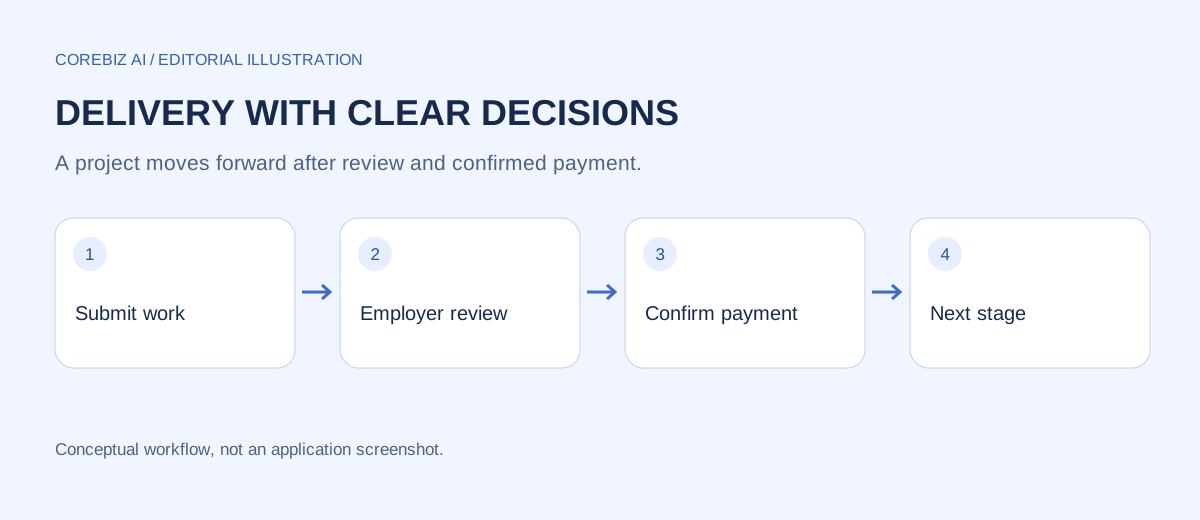
Under Stageflow's current approval-first workflow, employer approval makes the final stage payment available. Confirmation of that payment completes the stage and the project. These are distinct events: a delivered package can await review, and an accepted package can still await payment confirmation.
Explain this sequence before the closing meeting. The client should understand why they are asked to approve a delivery and later submit payment evidence. The administrator should verify receipt through the intended process, not mark it received simply because the handover discussion went well.
After closure, retain the references needed to understand the project history. A new contact may later ask what was approved or which package was delivered. Versioned submissions and recorded decisions help answer that question without recreating the entire conversation from memory.
Plan a useful handover meeting
Give the client the materials before the meeting so they can identify questions. During the session, ask the intended operator to perform an ordinary task while the studio observes. This can reveal an unclear instruction that a developer-led demonstration would miss.
End with a short list of named actions, if any remain. Each action should say who owns it and how completion will be communicated. Do not conclude with a vague promise to send everything later, because that leaves both the package and the acceptance decision uncertain.
Frequently asked questions
Is source code always part of handover?
That depends on the agreed scope and commercial arrangement. Do not infer it from the existence of a deployment or an administrator account. If source transfer is included, describe the location, version and supporting instructions that the client needs to use it appropriately.
Does project completion include unlimited support?
No such assumption should be made. Document the support arrangement that was actually agreed, including the contact route and the types of requests it covers. New features, routine administration and defect investigation may need different handling depending on that arrangement.
What if the client changes their operator?
A clear inventory, role description and operating guide help the replacement person take over. The responsible administrator should manage access through the supported process. Avoid relying on a single personal chat as the only record of how the application is run.
Conclusion
Prepare handover as a reviewable delivery with clear ownership, usable instructions and an honest record of limitations. Let the client inspect the package before accepting it, then follow the payment confirmation process. Closure should leave the next operator informed rather than dependent on undocumented memory.
Explore the project and implementation options
The Stageflow project page explains the available workspace and its access requirements. Use it to compare the process described here with the current application. The automation service page is a starting point for discussing additional workflow requirements; this article does not imply those customizations are already implemented.
Prepared with AI assistance and checked against the project source. Examples are fictional process illustrations, not customer results. GeM Flow is an independent internal workspace, not an official GeM service.
Discuss a focused implementation
Explore the service scope and share the process you want to improve.
Explore this service