
Keep the reason, not just the question
A notebook full of difficult questions can become another pile of material to avoid. For each mistake, write what you were trying to do and where the reasoning went wrong. Did you misunderstand a term, skip a step or rush the calculation? Those causes need different practice. A useful note helps you recognize the same problem when it appears in a new form.
Make the correction small enough to revisit
Record the question reference, your original approach, the corrected reasoning and one sentence explaining the difference. For a fictional example, a learner who confuses two units could note the conversion step they missed and work through a simple fresh example. Copying an entire chapter is usually harder to review than a correction tied to a specific misunderstanding.
Ask an assistant for another explanation
An AI learning tool may help rephrase a concept or prepare a practice question. Compare its explanation with your course material or a teacher-approved reference. If the answer seems inconsistent, keep the question open instead of memorizing the latest response. For practical trades, an explanation on a screen does not replace supervised workshop instruction or the procedures required by your training provider.
Check learning with a fresh question
Return to a few notes after a gap and try a similar question without looking at the correction first. Write down whether the original mistake returned. Group notes by the reason for the error so you can choose useful practice, rather than simply counting completed questions. The CoreBiz AI Books and SkillLab project pages describe the learning tools available and where to explore their current features.
Try a correction, reason and retry note
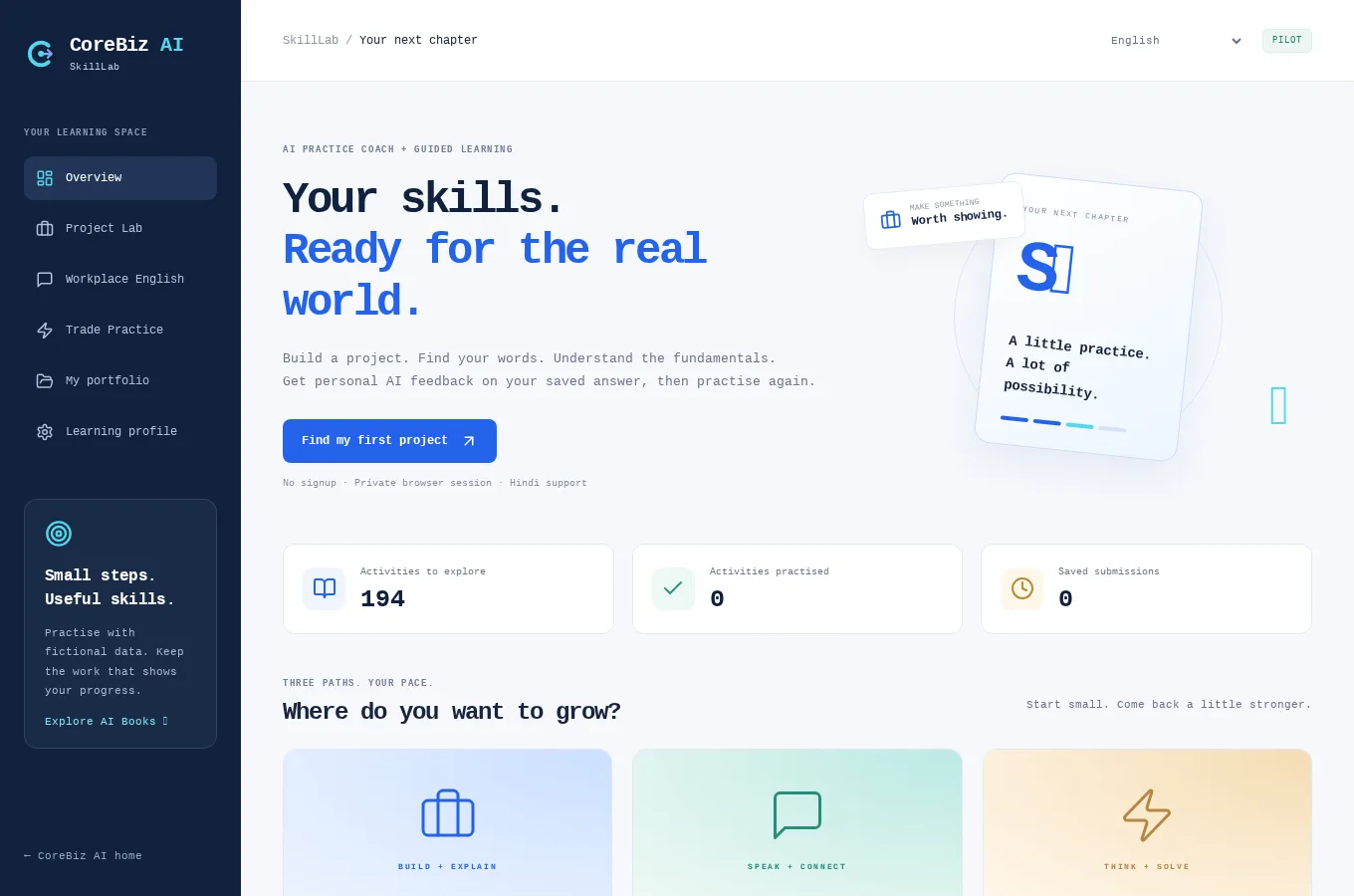
SkillLab provides a visible example of separate practice tracks in a fresh session. Its overview is not a demonstration of the AI Books Mistake Notebook, and the screenshot does not show student outcomes. Use each project page to check its actual learning features before choosing a tool.
- Correction: write the worked step that should replace the original answer.
- Reason: explain the misunderstanding in your own words, such as mixing a quantity with its unit.
- Retry: attempt a fresh question after a gap, then record whether the same error returned.
Make each note a small explanation you can revisit
Identify the kind of mistake before choosing practice
Two wrong answers can have different causes. One learner may understand the concept but rush a calculation; another may use the wrong definition from the beginning. Write the reason in ordinary language rather than copying the final solution. If you cannot explain the reason, ask a teacher, mentor or trusted reference to help locate the gap. This makes the notebook a guide to what to practise next. A collection organized only by question number can hide the fact that the same misunderstanding appears across several chapters or exercises with different surface details.
Record the original reasoning and the correction together
Keep enough of the original approach to recognize the error, then show the corrected step beside it. For a fictional units question, the note might explain that a conversion was skipped before combining quantities. Work through a simple fresh example using the corrected approach. Avoid copying pages of explanation if that makes the note too long to revisit. The useful unit is a specific misunderstanding, an understandable correction and a way to check it. Keep the source reference so you can return to the course material when a later example seems to contradict what you wrote.
Use a fresh question to test understanding
Trying the identical question immediately after reading the answer can test memory of that solution more than understanding of the method. Choose a related question with changed values or a slightly different setup. Attempt it without looking at the correction first, then explain why your steps make sense. Record whether the original mistake returned and whether the new task revealed another gap. You do not need a complicated scoring system to begin. A short history showing repeated causes and successful corrections can be enough to choose a more useful next practice session.
Let AI support an explanation without replacing the source
Ask for help that you can verify
An assistant may provide an alternative explanation, a guiding question or a new practice example. Compare the result with the course material and keep uncertainty visible. If two explanations disagree, do not resolve the conflict by choosing the one that sounds friendlier. Ask the relevant teacher or reference to settle the point. For trade learning, keep screen-based explanations separate from supervised workshop procedures and practical authorization. The SkillLab screenshot illustrates its public tracks; it is not a screenshot of the AI Books Mistake Notebook and does not show a learning outcome. Use the individual project descriptions to understand the different tools.
Frequently asked questions
How many mistakes should I record?
Choose the mistakes that reveal a repeated misunderstanding or a useful correction. Recording every slip can create a notebook too large to review. If a simple arithmetic error is already understood, a short reminder may be enough; a conceptual gap deserves a worked explanation.
How can I tell whether the notebook is helping?
Look for evidence that the same mistake returns less often on fresh questions and that you can explain the corrected reasoning without copying. If the note is repeatedly confusing, rewrite it with a simpler example or ask for help with the underlying concept.
A fictional revision session using the notebook
Consider a learner who repeatedly applies a formula before converting quantities into consistent units. The notebook entry should preserve a short example of that original approach, show the conversion step and explain why it must happen before substitution. After reading the correction, the learner attempts a related question with different values. They then describe the reason for the conversion without copying the explanation. This checks whether the note supports understanding rather than only recognition of a familiar answer.
At a later session, mix that question type with another concept so the learner has to notice when the conversion is relevant. Record whether the original error returns. If it does, simplify the worked example or ask a teacher to check whether another misunderstanding is involved. Avoid judging the routine only by the number of entries created or questions attempted. A small collection of notes that changes how the learner reasons can be more useful than a large archive they never revisit. This example is a suggested study exercise, not a measured outcome from SkillLab or AI Books.
- Keep the original reasoning visible but concise.
- Attempt a changed question without viewing the correction.
- Review repeated causes, not only the number of wrong answers.
Explore related CoreBiz AI resources
The links below connect this guide to the relevant CoreBiz service and project. Check the project page for its current features and access requirements before using the live tool.
Prepared with AI assistance. Business and learning scenarios are illustrative; no customer results, hiring outcomes or performance guarantees are implied.
Discuss a focused implementation
Explore the service scope and share the process you want to improve.
Explore this service